
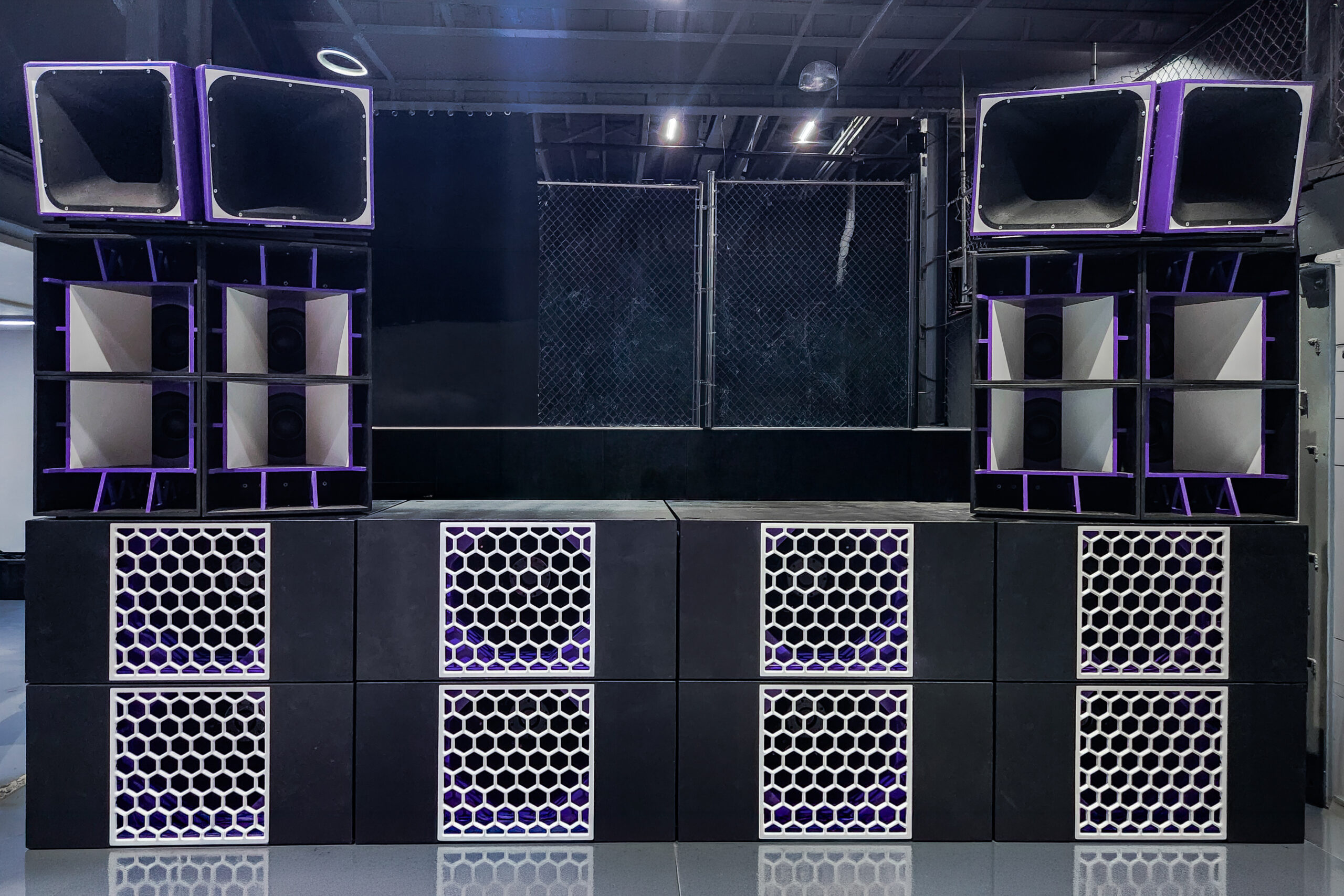
The HOQS Knowledge Base
Every PARAFLEX cabinet and HOQS driver in one place, with CNC flat packs and finished builds from Sarasota, Florida.
Every published PARAFLEX cabinet
Specs come from the official HOQS plans. Tap a card for the full design, download the free plan, or order a flat pack from WAAT.

PARAFLEX 2×8 Mid-Top V2
Compact trapezoid mid-top built around a pair of 8s. The complete drawing set is drawn for 15 mm sheet stock.
- Format
- Trapezoid
- Front
- 519 mm
- Rear
- 270 mm
- Body
- 459×681
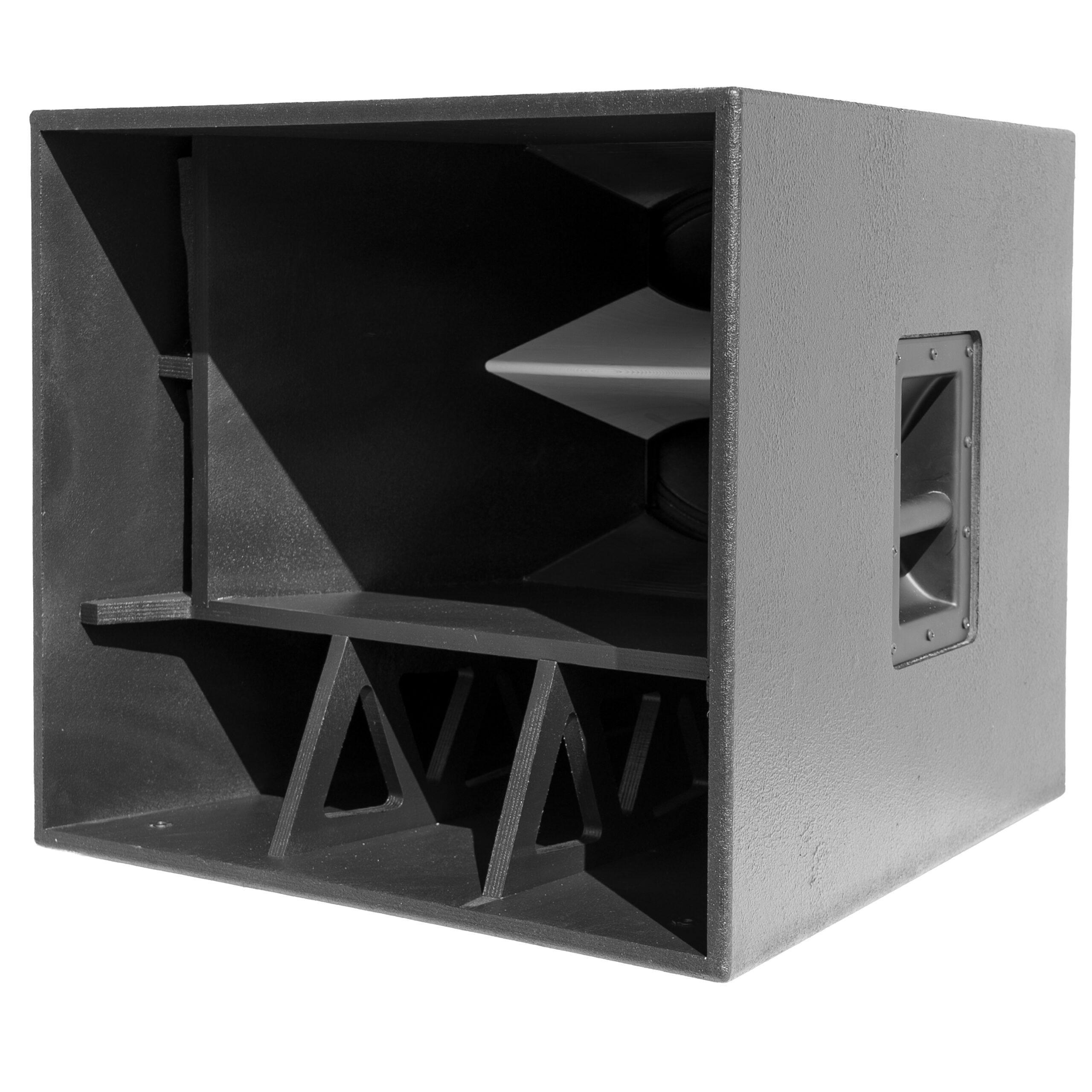
PARAFLEX C-3DKT 1×12
A 150-liter trapezoid kick-top that pulls 111 dB of sensitivity from a single 12, developed and verified by a team of more than twenty community test builders.
- Range
- 80–1k Hz
- Sens.
- 111 dB
- Peak
- 144 dB
- Weight
- ~47 lb

PARAFLEX G1V2 1×12
The refined single-12 kick-top. V2 introduces Helmholtz-tuned band-stop chambers that absorb midrange interference, on top of the low-tuned/high-tuned resonator layout that defines the family.
- Range
- 90–1k Hz
- Sens.
- 108 dB
- Peak
- 141 dB
- Weight
- ~48 lb

PARAFLEX Wide Style V2 2×12
Double-12 wide-body kick section. Band-stop chambers tame odd-order resonances for a smooth, tight midrange; crosses cleanly to HF at 800 Hz and takes a 70 Hz BW24 high-pass.
- Range
- 90–700 Hz
- Sens.
- 108 dB
- Peak
- 144 dB
- Weight
- ~70 lb
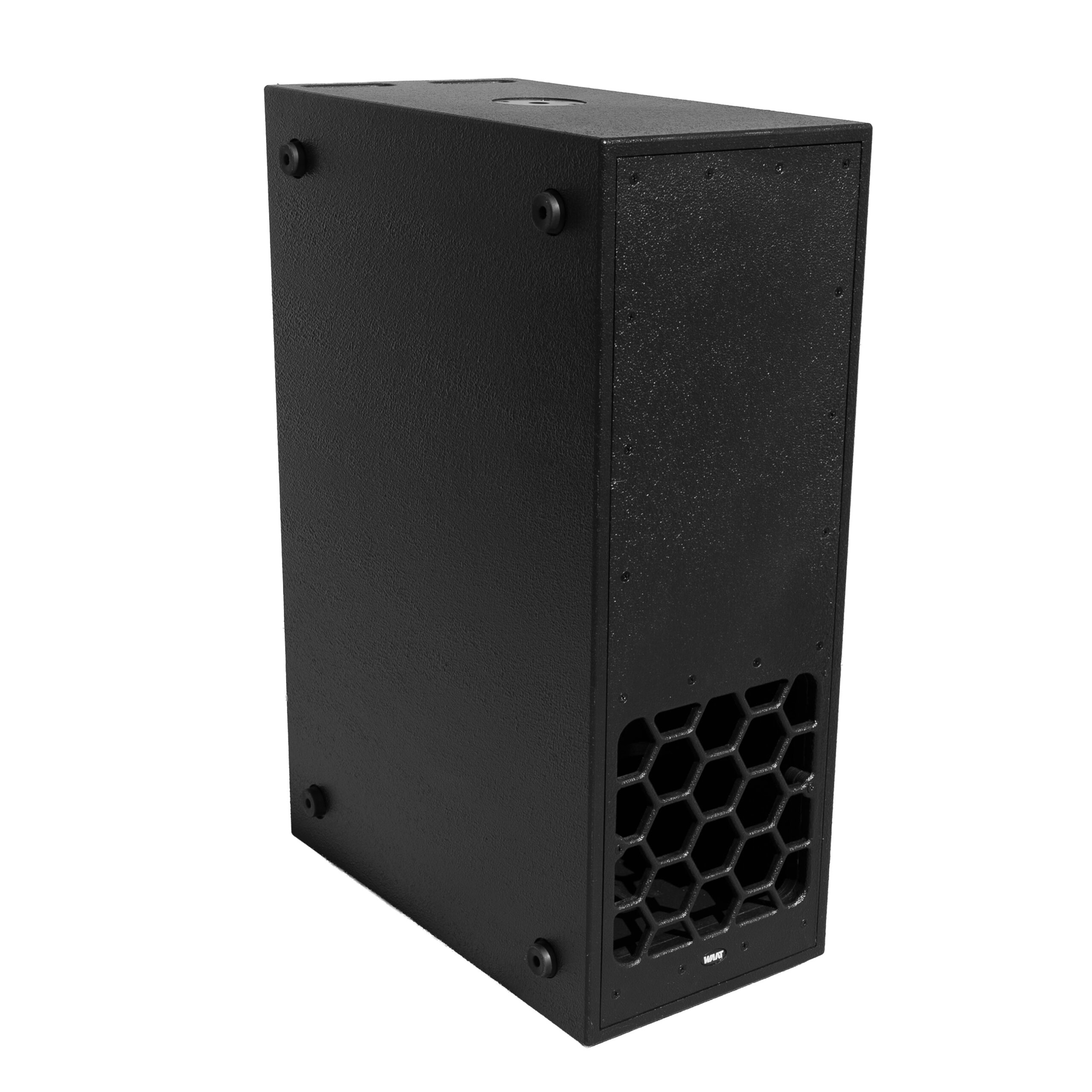
PARAFLEX CRAM 2×12 Type O V2
The small-format Type O workhorse. V2 resolves the earlier 130 Hz response dip and extends usable output to 180 Hz, plan for roughly 75% open-area grilles to keep the mouth breathing.
- Range
- 35–100 Hz
- Sens.
- 102 dB
- Peak
- 138 dB
- Weight
- ~82 lb
PARAFLEX Type O 35 Hz: Three-Cabinet Plan Set
One plan set, three cabinets: the 35 Hz Type O fold drawn for twin-15, single-18, and single-21 builds, each supplied as both PDF drawings and STEP CAD files for CNC work.
- Variants
- 3
- Tuning
- 35 Hz
- Files
- PDF+STEP

PARAFLEX CRAM 2×18 Type O
The flagship-scale double-18: 724 liters folded to deliver 140 dB continuous from a 30 Hz tune. Purpose-matched to the HOQS 18″ driver platform.
- Range
- 30–100 Hz
- Sens.
- 104.5 dB
- Peak
- 146 dB
- Weight
- ~180 lb
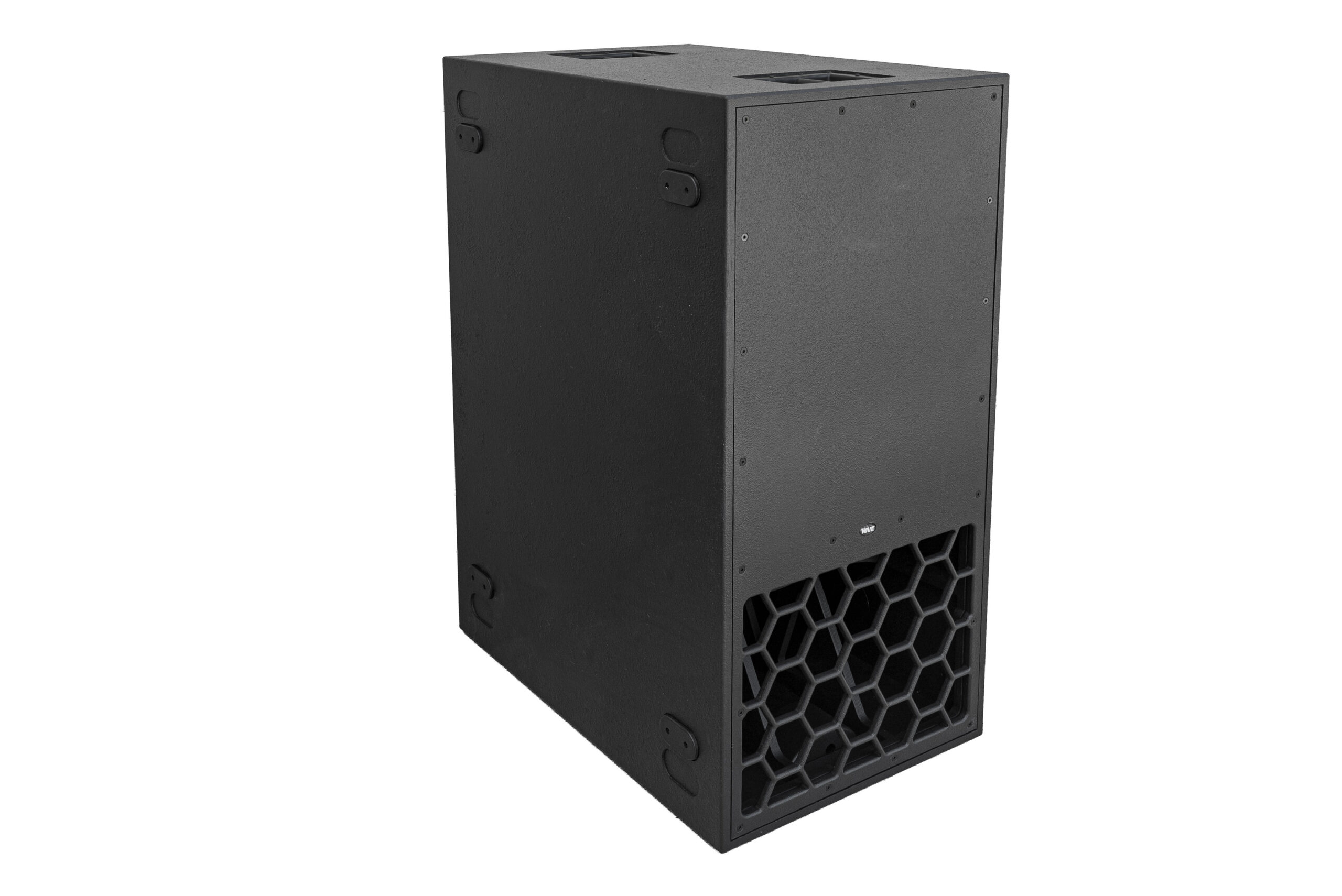
PARAFLEX 2×18 Type O “Playa Edition”
The forward-facing-driver rework of the double-18, reaching down to 25 Hz, built for open-air, festival, and desert-scale deployments.
- Reach
- 25 Hz
- Volume
- 703 L
- Weight
- ~180 lb

PARAFLEX 2×21 Type O, Forward Drivers
The biggest fold in the catalog: a 796-liter double-21 with forward-facing drivers and 25 Hz reach, for when the job simply cannot be too large.
- Reach
- 25 Hz
- Volume
- 796 L
- Weight
- ~193 lb

PARAFLEX C-CRAM 2×15 Type C
Compact-fold Type C drawn for twin 15s. Everything you need to build one (panels, fold, and hardware callouts) ships in the free plan PDF.
- Config
- 2×15″
- Family
- Type C
- Files

PARAFLEX Type C “Classic” V1
The original 35 Hz Classic cube for single 18s and 21s, with published measured response. Superseded by V2 but still a proven, widely built cabinet.
- Range
- 30–110 Hz
- Sens.
- 103 dB
- Peak
- 141 dB
- Weight
- ~147 lb

PARAFLEX Type C “Classic” V2
The do-everything Classic, redrawn: one 502-liter cabinet covering configurations from 12″ through 24″ drivers. Twin B&C 15DS115s tune to 31 Hz; a single HOQS N216C tunes to 32 Hz.
- Range
- 30–100 Hz
- Sens.
- ~102 dB
- Peak
- 140 dB
- Weight
- ~154 lb

PARAFLEX Type R 1×18
Single-18 Type R fold, matched to the HOQS 18″ driver platform. The complete drawing set is in the free plan; CNC files are available for kit production.
- Config
- 1×18″
- Family
- Type R
- Files
- PDF+DXF

PARAFLEX Type R 1×21
Single-21 Type R tuned at 30 Hz with usable output all the way up to 180 Hz, unusually wide bandwidth for a cabinet that digs this deep.
- Range
- 30–180 Hz
- Sens.
- 104 dB
- Peak
- 143 dB
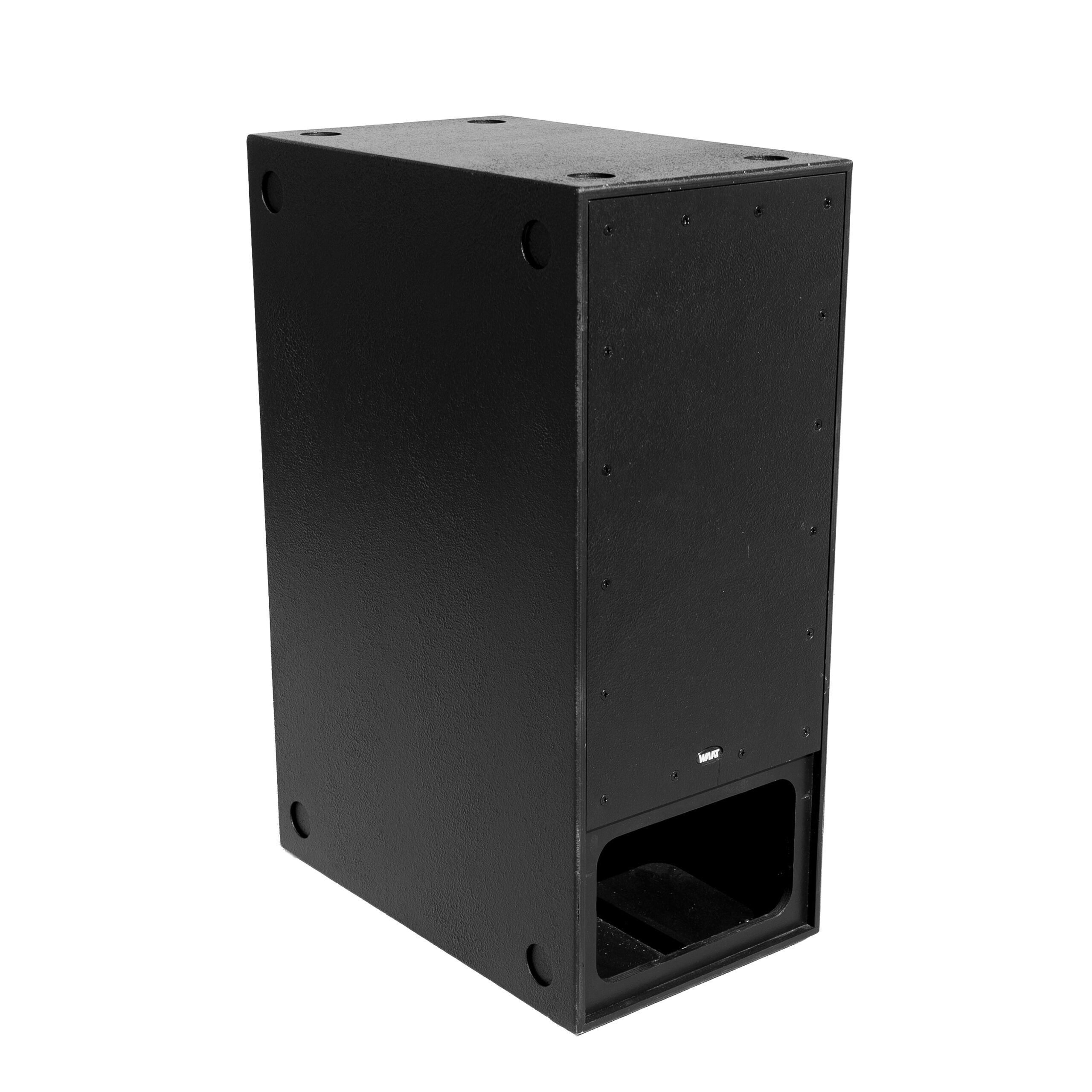
PARAFLEX Type A 1×12 V2
Compact single-12 quarterwave, published in both metric and imperial drawing sets, a 200-liter footprint that suits smaller rigs and first-time builders.
- Volume
- 200 L
- Weight
- ~101 lb
- Files
- PDF ×2
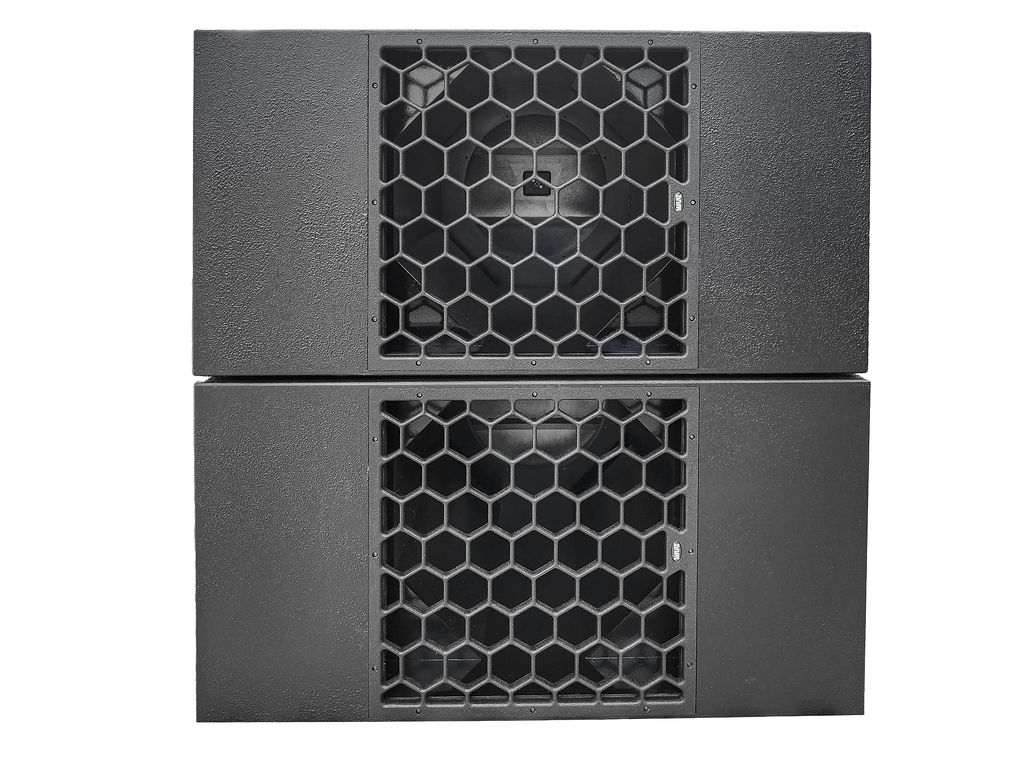
PARAFLEX C2E ELF
The deep-end specialist: 678 liters of extended low-frequency reach for single 18s and 21s, tuned at 28 Hz and proofed by a community test-build program.
- Range
- 28–120 Hz
- Sens.
- 105.5 dB
- Peak
- 144 dB
- Weight
- ~231 lb
Sensitivity figures are averaged across the stated operating band; SPL figures are half-space at one meter with the reference driver noted in each plan.
The HOQS driver line
Purpose-built for PARAFLEX loading, FEA-modeled motors, carbon fiber cones on the LF units, and compliance profiles chosen for folded horn work. All models are 8 Ω. Recone and diaphragm kits are available.

HOQS HF143N
1.4″ compression driver with a 3″ edge-wound aluminum coil, titanium diaphragm, and a copper shorting ring for distortion control. Cross at 800 Hz with a BW24 filter. Diaphragm kits available.
Full specifications
| Throat exit | 35.6 mm (1.4″) |
| Voice coil | 75 mm (3″) edge-wound aluminum, Kapton former |
| Flux density | 1.9 T |
| Recommended crossover | 800 Hz, BW24 |
| Dimensions | 125 mm OD × 55 mm deep · 102 mm bolt circle, 4× M6 |
| Net weight | 2 kg (4.4 lb) |
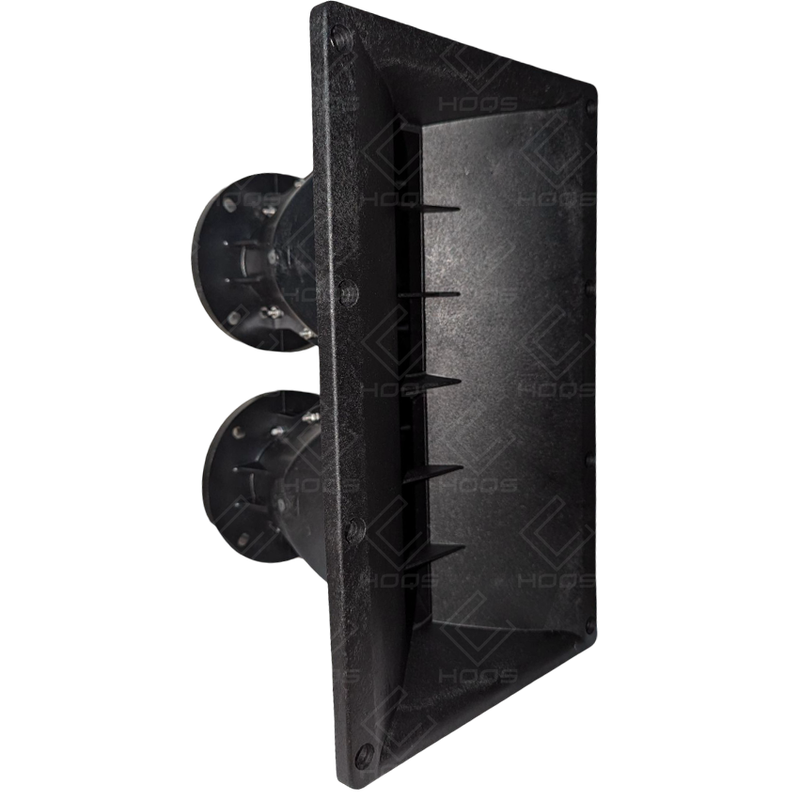
HOQS WG6
Line-source waveguide that stacks two 1.4″ compression drivers into an arrayable vertical element, published response measured with the HF143N. The HF building block for line-array-style PARAFLEX tops.
Full specifications
| Configuration | Dual 1.4″ (38 mm) throat entries, line source |
| Dimensions | 330 mm H × 195 mm W × 195 mm D |
| Driver mount | Angled slotted holes, up to 6.5 mm bolts, 99–103 mm radius |
| Cabinet mount | 8× 6 mm holes with 11 mm head recess, 3 mm deep |
| Reference driver | HOQS HF143N |

HOQS BH1 Horn
Point-source fiberglass horn designed as the HF section for PARAFLEX tops. Ships with a 1.4″-to-2″ throat adaptor; published response was measured with the HF143N on that adaptor.
Full specifications
| Dimensions | 567 × 372 × 310 mm (to 360 mm with adaptor) |
| Baffle cutout | 467 × 308 mm |
| Driver mount | 102 mm bolt circle, 4× M6 |
| Weight | 3.5 kg (7.7 lb) |

HOQS N62C
6″ carbon fiber cone mid with a 2″ OFC coil. High sensitivity, low distortion, and a compliance profile tailored to horn loading, the reference driver for the arrayable MidWave module.
Full specifications
| Fs / Re / Qts | 95.7 Hz / 5.5 Ω / 0.27 |
| Xmax / BL | 5 mm / 15 T·m |
| Vas / Sd | 3.95 L / 136.85 cm² |
| Le @1kHz / EBP | 0.389 mH / 353.7 |
| Power | 200 W nominal / 400 W program |
| Dimensions | 161 mm OD · 147 mm cutout · 83 mm deep · 1.96 kg |

HOQS N123
The reference 12″ for PARAFLEX kick-tops: FEA-modeled neo motor, weather-treated paper cone, 3″ two-layer OFC coil, and a light, high-compliance moving system built for horn-loaded mids.
Full specifications
| Fs / Re / Qts | 37 Hz / 5.8 Ω / 0.16 |
| Xmax / Xmech | 6.3 mm / 32 mm p-p |
| BL / Vas / Sd | 25.5 T·m / 97 L / 532 cm² |
| Le @1kHz / EBP | 0.79 mH / 231 |
| Power | 500 W nominal / 1000 W program |
| Dimensions | 320 mm OD · 281 mm cutout · 143 mm deep · 4.7 kg |
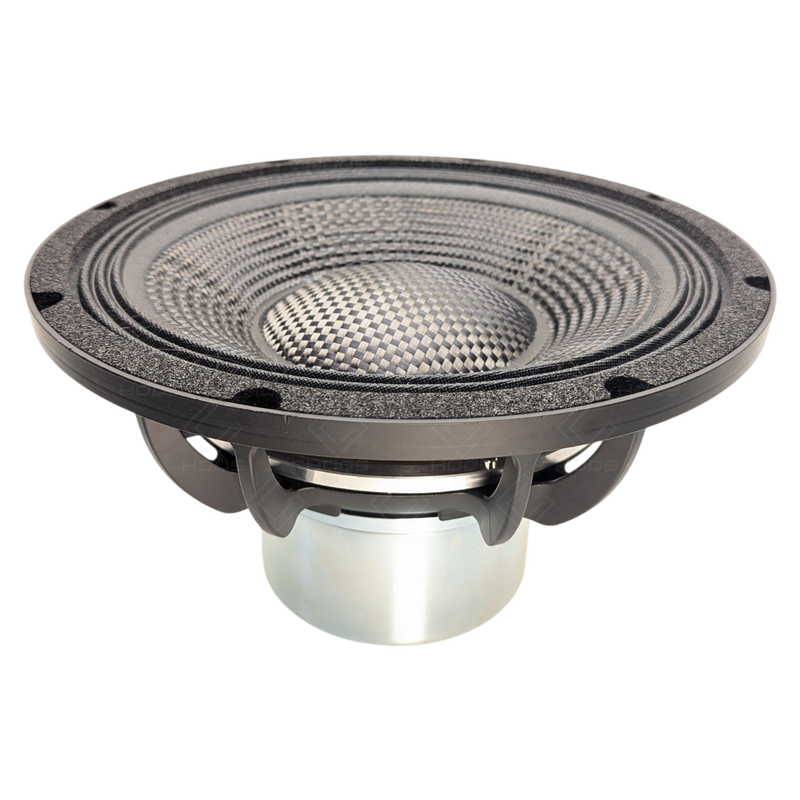
HOQS N124C
12″ neo subwoofer driver with a 4″ voice coil and carbon cone, optimized for PARAFLEX loading, the reference driver for the CRAM 2×12 Type O.
Full specifications
| Fs / Re / Qts | 32.8 Hz / 5.75 Ω / 0.29 |
| Xmax / Xvar | 15 mm one-way / 28 mm one-way |
| BL / Vas / Sd | 25.5 T·m / 58.12 L / 532 cm² |
| Le @1kHz / EBP | 1.6 mH / 110 |
| Power | 1000 W nominal / 2000 W program |
| Voice coil | 100 mm (4″) |
| Mounting | 315 mm OD · 300 mm bolt circle · 275/285 mm cutout · 175 mm deep · 8.4 kg (18.5 lb) |

HOQS F185C
18″ carbon fiber cone sub driver on a 30 mm Y35 ferrite motor with a 5″ OFC coil and dual treated spiders. The ferrite twin of the N185C, same performance, more mass, less cost. Recone kits available.
Full specifications
| Fs / Re / Qts | 29.5 Hz / 5.7 Ω / 0.23 |
| Xmax / Xmech | 13.5 mm one-way / 56 mm p-p |
| BL / Vas / Sd | 34.54 T·m / 242 L / 1225 cm² |
| Mms / η₀ | 281.5 g / 2.11% |
| Power | 1700 W nominal / 3400 W program |
| Mounting | 442 mm bolt circle · 424 mm cutout · 21.5 kg (47 lb) |

HOQS N185C
The neodymium 18: same 5″ coil and carbon cone as the F185C at roughly 18 pounds lighter per driver, the pick when a double-18 cabinet already weighs enough. Recone kits available.
Full specifications
| Fs / Re / Qts | 29.5 Hz / 5.7 Ω / 0.21 |
| Xmax / Xmech | 13.5 mm one-way / 58 mm p-p |
| BL / Vas / Sd | 35.7 T·m / 242 L / 1225 cm² |
| Mms / η₀ | 281.5 g / 2.36% |
| Power | 1700 W nominal / 3400 W program |
| Mounting | 461 mm OD · 442 mm bolt circle · 424 mm cutout · 13.5 kg (30 lb) |

HOQS N216C
The 21″ flagship: 6″ OFC coil on a ventilated former, spaced dual spiders for controlled high compliance, carbon fiber cone. The first-choice driver for the largest Type O and ELF builds.
Full specifications
| Fs / Re / Qts | 29.46 Hz / 6 Ω / 0.30 |
| Xmax / Xmech | 13.5 mm one-way / 54 mm p-p |
| BL / Vas / Sd | 38 T·m / 290 L / 1669 cm² |
| η₀ | 2.374% |
| Power | 2000 W nominal / 4000 W program |
| Mounting | 545 mm OD · 522 mm bolt circle · 495 mm cutout · 256 mm deep · 20.9 kg (46 lb) |
How PARAFLEX works
Quarterwave loading, put to work
PARAFLEX cabinets load the driver into a network of tuned resonator paths, low-tuned and high-tuned sections working together, instead of a simple ported box. The payoff is considerably more acoustic output per cubic foot, with the newest generations adding Helmholtz band-stop chambers that clean up midrange resonances older folded designs struggled with.
One system, several families
The library spans mid-tops and kick-tops through four subwoofer families, Type O (including the compact CRAM folds), the Type C “Classic” line, Type R, and the Type A compacts, plus a dedicated ELF design, with tunings running from 25 Hz up to 80 Hz depending on the job.
Open plans, proven by builders
HOQS PARAFLEX was founded in coordination with Matthew Morgan J, Dustin Morgan, and J Vansickle, then refined by a worldwide development community of test builders. Every plan is published free under Creative Commons BY-NC-ND 4.0, with revisions driven by real measurements from real builds.
Several tuned paths, one mouth
Inside each PARAFLEX cabinet, compound quarter-wave loading splits the driver's output into several resonator paths, each with its own length and tuning: a long, low-tuned path and a short, high-tuned one. They sum at the mouth into one wide, even band, and the geometry gives a forward-biased cardioid pattern with some passive rejection behind the cabinet.
More output from less amplifier
Because the acoustic loading does much of the work, HOQS rates PARAFLEX cabinets at over 100 dB sensitivity. Reaching a target level takes a fraction of the amplifier power a conventional box needs, which HOQS says means lower distortion, cooler voice coils and more headroom when the system is pushed.
Why HOQS builds its own drivers
PARAFLEX loading puts sustained, uneven pressure on the cone, which off-the-shelf drivers aren't built for. HOQS designs its drivers for that load: stiff carbon fiber cones that move as a piston, softer suspensions with strong magnets for fast, accurate excursion, and coil coatings, venting and an optimized magnet gap to pull heat off the coil.
From plan to cabinet, three ways to get there
Build from the free plans
You can download any PARAFLEX design directly from above, full drawings, panel schedules, and driver recommendations, published free by HOQS under Creative Commons BY-NC-ND 4.0 for personal builds.
Order a CNC flat pack
Skip the table saw. WAAT cuts PARAFLEX flat packs on CNC from the official geometry, every dado, brace, and driver cutout machined, labeled, and ready for glue-up, shipped anywhere in the Americas. Kits can also include conveniences the plans leave out, like routed handle and feet recesses, or solid wood handles like the ones on our Type C builds.
Have WAAT build it
Finished cabinets, assembled and finished in Sarasota, loaded with HOQS or spec-alternative drivers, wired, tested, and processed before they leave the shop.
A note on custom drafting: HOQS has paused its custom DXF drafting service. For builders in the Americas, WAAT handles CNC file preparation and flat-pack production for the published catalog directly, reach out with the design you're after.
Start your build with WAATWatch a kit go together
Step-by-step assembly walk-throughs from the WAAT shop. Tap a thumbnail to play it.
More videos, tuning guides and questions: event recaps, the system tuning guide and the Ask the Builders form live in the WAAT Knowledge Base.
From the HOQS community
Long-form write-ups from builders in the HOQS group, republished with permission. New Builder Notes posts show up here on their own.
Thermal Management Strategies in Subwoofer Systems
Cabinet ratios, power headroom, processing, clipping, and how to set peak and RMS limiters so your subs survive long, loud gigs.
Read the article →
The Type O Playa Edition Update, Explained
Why the front panel on the Type O CRAM! 2x18 and 2x21 Playa Edition grew 7 inches, and what it did for ringing around 90 Hz.
Read the article →Driver power ratings: what do they mean?
Bennett Prescott walks through AES, program, and peak ratings, a good companion to the thermal management article.
Run & Gun Subs: simplifying subwoofer arrays
Bennett Prescott on why common subwoofer setups cover a room poorly, and the simple, free layout changes that fix it.
Download the PDF ↓More from Guide 6: Operation & Gear
The rest of the HOQS group’s Operation & Gear guide. Each entry links to the original post, where the full write-up, charts and discussion live.
Subwoofers, arrays and coupling
Analyze your tracks to find your sub-bass needs
A free method (Foobar2000 and a few plugins) for measuring how low the music you actually play goes, so you can pick a subwoofer tuning that fits. Includes a PDF walkthrough.
Read in the HOQS group ↗Coupling effects of arrayed ELF subwoofers
Indoor measurements from a group of C-2E ELF subwoofers (28 Hz Paraflex), showing how the response changes as cabinets are grouped together.
Read in the HOQS group ↗Coupling multiple Paraflex subs: real world vs. simulation
Outdoor measurements at 20 m of one, two and four small Type C subs, compared with the Hornresp prediction, which turned out optimistic.
Read in the HOQS group ↗Side and rear rejection of four Type C subwoofers
Four Type C 1×18 cabinets coupled together and measured at 20 m, on-axis versus off-axis.
Read in the HOQS group ↗Nathan Lively on subwoofer arrays
A talk through ground-stacked, vertically stacked, flown and arc subwoofer arrays and the topics around them.
Read in the HOQS group ↗The house curve
A thread on target response curves for PA systems, with members sharing what they tune toward and why.
Read in the HOQS group ↗Decibels in relation to phons
A psychoacoustics reference on how perceived loudness changes with frequency and level.
Read in the HOQS group ↗Setup, tuning and processing
Phase alignment between subs and tops
A builder asks how to set delay between a single C-2E sub and powered tops without measurement gear. The replies collect methods, links and advice.
Read in the HOQS group ↗Rackmount DSP and speaker management
What members use for crossovers and splitting bands between cabinets.
Read in the HOQS group ↗BREAKAWAY multi-band processor
Software that auto-levels and EQs music played from a PC, shared with the group as a download.
Read in the HOQS group ↗Acoustic treatment example
Photos of a treated studio room, with discussion of commercial versus home listening spaces.
Read in the HOQS group ↗Power and amplification
2 ohm loads and digital PA amplifiers
Can budget digital amplifiers be trusted at 2 ohms? A long thread on reliability and sound at low impedance.
Read in the HOQS group ↗120 V, 220 V and 240 V power distribution
Why a standard 120 V US circuit limits big amplifier racks, and how builders plan power distribution.
Read in the HOQS group ↗What is power factor correction (PFC)?
An explainer on PFC in the switch-mode power supplies used by modern amplifiers.
Read in the HOQS group ↗Portable 12 V PA systems
A guide to battery-powered rigs, from early lead-acid builds to 1.5 kW (about 20 hours) and 4.5 kW (about 8 hours) systems.
Read in the HOQS group ↗Drivers and horns
Compression driver technology
A B&C and 18Sound walkthrough covering diaphragm materials, maximum output, top-octave response and why beryllium costs what it does.
Read in the HOQS group ↗Affordable compression drivers that sound good
Members share their favorite budget 1-inch and 1.4-inch HF and MF drivers.
Read in the HOQS group ↗Large horns for HF and upper midrange
Builders pairing large EV and JBL horns with Paraflex tops.
Read in the HOQS group ↗Vintage Altec horn vs. a modern horn
A side-by-side comparison of a classic Altec horn and driver against a modern biradial horn.
Read in the HOQS group ↗Fix for the SB Audience Nero 18SW1100D
A gasket with split joints can cause a flapping noise at level. The video shows how to find it and fix it.
Read in the HOQS group ↗Quarterwave questions, answered
What makes a PARAFLEX different from a regular ported sub?
A ported (bass reflex) box uses one tuned resonance. PARAFLEX designs are high-order quarterwave systems: the driver works into a series of tuned resonator sections that stack their contributions across the passband. In practice that means noticeably higher output from the same driver and amplifier, at the cost of a more complex yet still manageable fold, as all PARAFLEX subwoofer designs feature almost exclusively 90-degree cuts.
What do Type O, Type C, Type R, and Type A mean?
They're distinct fold geometries within the PARAFLEX system, each drawn in multiple driver sizes. In the current catalog, the Type O family (including the compact CRAM folds and the forward-driver “Playa” editions) covers the highest-output builds with tunings from 25 to 37 Hz; Type C “Classic” is the versatile all-rounder now drawn for everything from twin 15s to a single 21; Type R is the single-driver fold with unusually wide bandwidth; and Type A is the compact entry point. The kick-tops and mid-tops apply the same resonator approach to the 80 Hz-and-up range.
Are the plans really free?
Yes. HOQS publishes every PARAFLEX plan free under Creative Commons BY-NC-ND 4.0. Under that license, individuals may build up to four cabinets for personal use. The plans can't be resold or modified and republished, and commercial production runs through authorized builders like WAAT.
Why buy a flat pack instead of cutting my own?
You can cut your own, and plenty of builders do. Most PARAFLEX cuts are simple 90-degree cuts, so the challenge isn’t the angles; it’s accuracy. Every panel has to be cut to its exact dimension or the joints won’t close, and small gaps let air leak and rattle. A CNC flat pack arrives with every panel cut to the published dimensions, dados that locate each panel and brace, and the driver, jack plate and handle cutouts already done. Assembly becomes gluing and clamping instead of measuring and re-cutting, and you skip buying full sheets of Baltic birch and the tools to break them down.
What kind of drivers can I use in a PARAFLEX?
Each plan lists the drivers it was designed and tested with, from brands like B&C, Beyma, 18Sound, Faital Pro, BMS, RCF, LaVoce and HOQS, and the published SPL figures name the reference driver used. The right choice depends on the cabinet and the job, so start from the plan’s list and ask us if you’re unsure. Quarterwave cabinets are far less forgiving of driver swaps than ported boxes, so check before substituting a model that isn’t listed. Our flat packs are cut for the driver you choose at checkout.
How does WAAT relate to HOQS?
HOQS is the design organization and worldwide community behind PARAFLEX; WAAT Audio is an authorized builder based in Sarasota, Florida, serving the Southeast and beyond, supplying CNC flat packs, HOQS drivers, and finished cabinets built to the official documentation. Design credit for everything on this page belongs to HOQS and its development community; the deepest well of build knowledge is the HOQS Facebook group, where these designs were born and are still being refined.