
The Quarterwave Knowledge Base
WAAT Audio is an authorized HOQS builder and the Southeast's home for the PARAFLEX catalog — the family of high-order quarterwave loudspeakers engineered and refined globally by the High Order Quarterwave Society's worldwide builder community. This page gathers the entire published catalog in one place: every cabinet design, the full HOQS driver line, and the path from a free plan to a CNC-cut flat pack built here in Florida.
Quarterwave loading, put to work
PARAFLEX cabinets load the driver into a network of tuned resonator paths — low-tuned and high-tuned sections working together — instead of a simple ported box. The payoff is considerably more acoustic output per cubic foot, with the newest generations adding Helmholtz band-stop chambers that clean up midrange resonances older folded designs struggled with.
One system, several families
The library spans mid-tops and kick-tops through four subwoofer families — Type O (including the compact CRAM folds), the Type C “Classic” line, Type R, and the Type A compacts — plus a dedicated ELF design, with tunings running from 25 Hz up to 80 Hz depending on the job.
Open plans, proven by builders
HOQS PARAFLEX was founded in coordination with Matthew Morgan J, Dustin Morgan, and J Vansickle, then refined by a worldwide development community of test builders. Every plan is published free under Creative Commons BY-NC-ND 4.0, with revisions driven by real measurements from real builds.
Every published PARAFLEX cabinet
Specifications summarized from the official HOQS plan documentation. Click any tile for the full design breakdown; plan buttons download the official drawings directly. Sensitivity figures are averaged across the stated operating band; SPL figures are half-space at one meter with the reference driver noted in each plan.
PARAFLEX 2×8 Mid-Top V2
Compact trapezoid mid-top built around a pair of 8s. The complete drawing set is drawn for 15 mm sheet stock.
- Format
- Trapezoid
- Front
- 519 mm
- Rear
- 270 mm
- Body
- 459×681

PARAFLEX C-3DKT 1×12
A 150-liter trapezoid kick-top that pulls 111 dB of sensitivity from a single 12 — developed and verified by a team of more than twenty community test builders.
- Range
- 80–1k Hz
- Sens.
- 111 dB
- Peak
- 144 dB
- Weight
- ~47 lb

PARAFLEX G1V2 1×12
The refined single-12 kick-top. V2 introduces Helmholtz-tuned band-stop chambers that absorb midrange interference, on top of the low-tuned/high-tuned resonator layout that defines the family.
- Range
- 90–1k Hz
- Sens.
- 108 dB
- Peak
- 141 dB
- Weight
- ~48 lb

PARAFLEX Wide Style V2 2×12
Double-12 wide-body kick section. Band-stop chambers tame odd-order resonances for a smooth, tight midrange; crosses cleanly to HF at 800 Hz and takes a 70 Hz BW24 high-pass.
- Range
- 90–700 Hz
- Sens.
- 108 dB
- Peak
- 144 dB
- Weight
- ~70 lb

PARAFLEX CRAM 2×12 Type O V2
The small-format Type O workhorse. V2 resolves the earlier 130 Hz response dip and extends usable output to 180 Hz — plan for roughly 75% open-area grilles to keep the mouth breathing.
- Range
- 35–100 Hz
- Sens.
- 102 dB
- Peak
- 138 dB
- Weight
- ~82 lb
PARAFLEX Type O 35 Hz — Three-Cabinet Plan Set
One plan set, three cabinets: the 35 Hz Type O fold drawn for twin-15, single-18, and single-21 builds, each supplied as both PDF drawings and STEP CAD files for CNC work.
- Variants
- 3
- Tuning
- 35 Hz
- Files
- PDF+STEP

PARAFLEX CRAM 2×18 Type O
The flagship-scale double-18: 724 liters folded to deliver 140 dB continuous from a 30 Hz tune. Purpose-matched to the HOQS 18″ driver platform.
- Range
- 30–100 Hz
- Sens.
- 104.5 dB
- Peak
- 146 dB
- Weight
- ~180 lb

PARAFLEX 2×18 Type O “Playa Edition”
The forward-facing-driver rework of the double-18, reaching down to 25 Hz — built for open-air, festival, and desert-scale deployments.
- Reach
- 25 Hz
- Volume
- 703 L
- Weight
- ~180 lb
PARAFLEX 2×21 Type O, Forward Drivers
The biggest fold in the catalog: a 796-liter double-21 with forward-facing drivers and 25 Hz reach, for when the job simply cannot be too large.
- Reach
- 25 Hz
- Volume
- 796 L
- Weight
- ~193 lb

PARAFLEX C-CRAM 2×15 Type C
Compact-fold Type C drawn for twin 15s. Everything you need to build one — panels, fold, and hardware callouts — ships in the free plan PDF.
- Config
- 2×15″
- Family
- Type C
- Files

PARAFLEX Type C “Classic” V1
The original 35 Hz Classic cube for single 18s and 21s, with published measured response. Superseded by V2 but still a proven, widely built cabinet.
- Range
- 30–110 Hz
- Sens.
- 103 dB
- Peak
- 141 dB
- Weight
- ~147 lb
PARAFLEX Type C “Classic” V2
The do-everything Classic, redrawn: one 502-liter cabinet covering configurations from 12″ through 24″ drivers. Twin B&C 15DS115s tune to 31 Hz; a single HOQS N216C tunes to 32 Hz.
- Range
- 30–100 Hz
- Sens.
- ~102 dB
- Peak
- 140 dB
- Weight
- ~154 lb

PARAFLEX Type R 1×18
Single-18 Type R fold, matched to the HOQS 18″ driver platform. The complete drawing set is in the free plan; CNC files are available for kit production.
- Config
- 1×18″
- Family
- Type R
- Files
- PDF+DXF

PARAFLEX Type R 1×21
Single-21 Type R tuned at 30 Hz with usable output all the way up to 180 Hz — unusually wide bandwidth for a cabinet that digs this deep.
- Range
- 30–180 Hz
- Sens.
- 104 dB
- Peak
- 143 dB
PARAFLEX Type A 1×12 V2
Compact single-12 quarterwave, published in both metric and imperial drawing sets — a 200-liter footprint that suits smaller rigs and first-time builders.
- Volume
- 200 L
- Weight
- ~101 lb
- Files
- PDF ×2

PARAFLEX C2E ELF
The deep-end specialist: 678 liters of extended low-frequency reach for single 18s and 21s, tuned at 28 Hz and proofed by a community test-build program.
- Range
- 28–120 Hz
- Sens.
- 105.5 dB
- Peak
- 144 dB
- Weight
- ~231 lb
The HOQS driver line
Purpose-built for PARAFLEX loading — FEA-modeled motors, carbon fiber cones on the LF units, and compliance profiles chosen for folded horn work. All models are 8 Ω. WAAT stocks and supplies HOQS drivers; recone and diaphragm kits are available. Ask WAAT for current stock and pricing on any model.
HOQS HF143N
1.4″ compression driver with a 3″ edge-wound aluminum coil, titanium diaphragm, and a copper shorting ring for distortion control. Cross at 800 Hz with a BW24 filter. Diaphragm kits available.
Full specifications
| Throat exit | 35.6 mm (1.4″) |
| Voice coil | 75 mm (3″) edge-wound aluminum, Kapton former |
| Flux density | 1.9 T |
| Recommended crossover | 800 Hz, BW24 |
| Dimensions | 125 mm OD × 55 mm deep · 102 mm bolt circle, 4× M6 |
| Net weight | 2 kg (4.4 lb) |
HOQS WG6
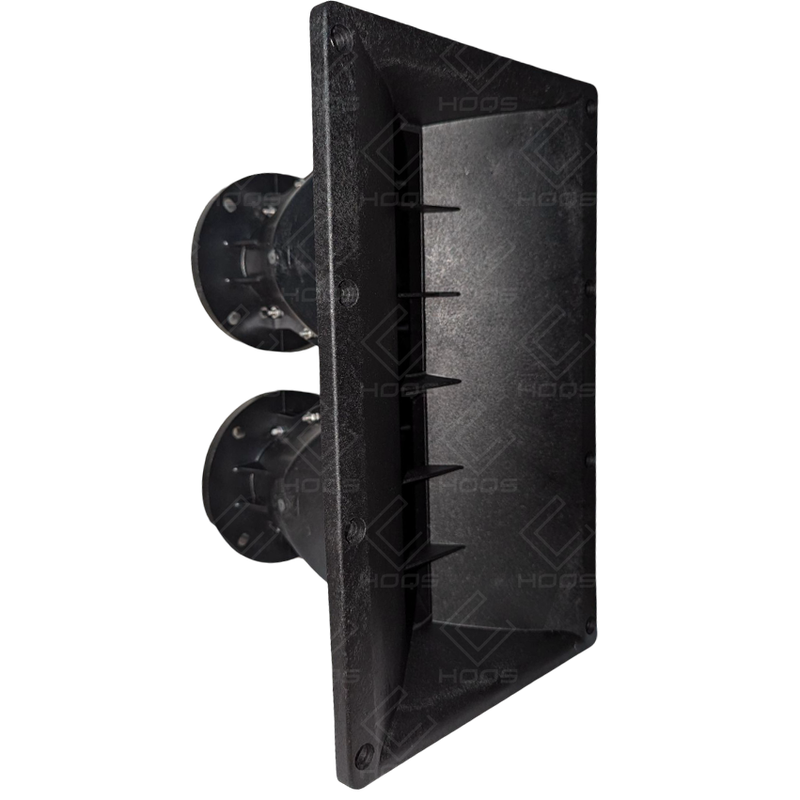
Line-source waveguide that stacks two 1.4″ compression drivers into an arrayable vertical element — published response measured with the HF143N. The HF building block for line-array-style PARAFLEX tops.
Full specifications
| Configuration | Dual 1.4″ (38 mm) throat entries, line source |
| Dimensions | 330 mm H × 195 mm W × 195 mm D |
| Driver mount | Angled slotted holes, up to 6.5 mm bolts, 99–103 mm radius |
| Cabinet mount | 8× 6 mm holes with 11 mm head recess, 3 mm deep |
| Reference driver | HOQS HF143N |

HOQS BH1 Horn
Point-source fiberglass horn designed as the HF section for PARAFLEX tops. Ships with a 1.4″-to-2″ throat adaptor; published response was measured with the HF143N on that adaptor.
Full specifications
| Dimensions | 567 × 372 × 310 mm (to 360 mm with adaptor) |
| Baffle cutout | 467 × 308 mm |
| Driver mount | 102 mm bolt circle, 4× M6 |
| Weight | 3.5 kg (7.7 lb) |

HOQS N62C
6″ carbon fiber cone mid with a 2″ OFC coil. High sensitivity, low distortion, and a compliance profile tailored to horn loading — the reference driver for the arrayable MidWave module.
Full specifications
| Fs / Re / Qts | 95.7 Hz / 5.5 Ω / 0.27 |
| Xmax / BL | 5 mm / 15 T·m |
| Vas / Sd | 3.95 L / 136.85 cm² |
| Le @1kHz / EBP | 0.389 mH / 353.7 |
| Power | 200 W nominal / 400 W program |
| Dimensions | 161 mm OD · 147 mm cutout · 83 mm deep · 1.96 kg |

HOQS N123
The reference 12″ for PARAFLEX kick-tops: FEA-modeled neo motor, weather-treated paper cone, 3″ two-layer OFC coil, and a light, high-compliance moving system built for horn-loaded mids.
Full specifications
| Fs / Re / Qts | 37 Hz / 5.8 Ω / 0.16 |
| Xmax / Xmech | 6.3 mm / 32 mm p-p |
| BL / Vas / Sd | 25.5 T·m / 97 L / 532 cm² |
| Le @1kHz / EBP | 0.79 mH / 231 |
| Power | 500 W nominal / 1000 W program |
| Dimensions | 320 mm OD · 281 mm cutout · 143 mm deep · 4.7 kg |
HOQS N124C
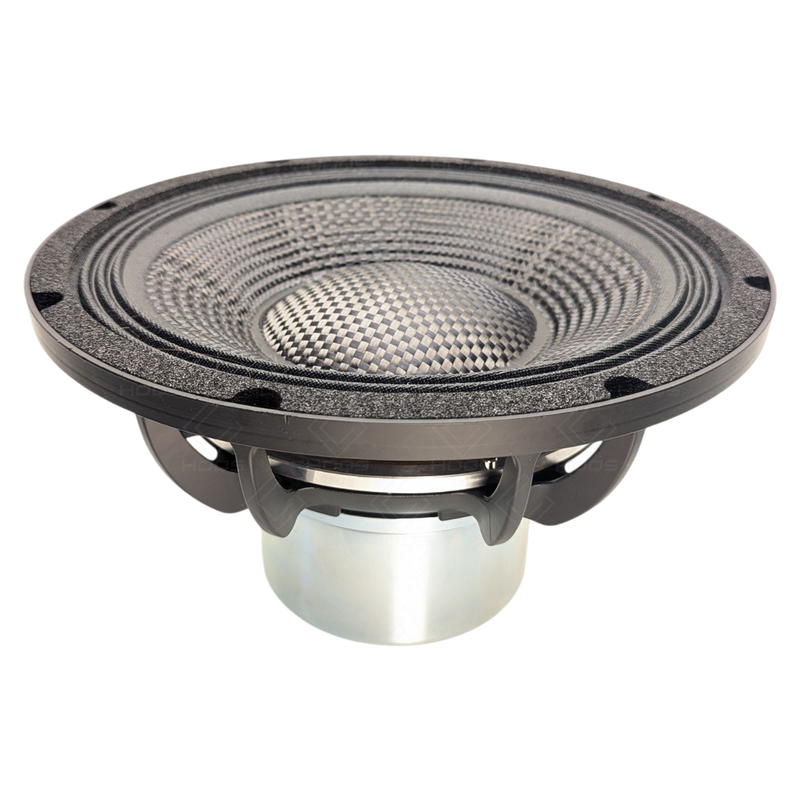
12″ neo subwoofer driver with a 4″ voice coil and carbon cone, optimized for PARAFLEX loading — the reference driver for the CRAM 2×12 Type O.
Full specifications
| Fs / Re / Qts | 32.8 Hz / 5.75 Ω / 0.29 |
| Xmax / Xvar | 15 mm one-way / 28 mm one-way |
| BL / Vas / Sd | 25.5 T·m / 58.12 L / 532 cm² |
| Le @1kHz / EBP | 1.6 mH / 110 |
| Power | 1000 W nominal / 2000 W program |
| Voice coil | 100 mm (4″) |
| Mounting | 315 mm OD · 300 mm bolt circle · 275/285 mm cutout · 175 mm deep · 8.4 kg (18.5 lb) |

HOQS F185C
18″ carbon fiber cone sub driver on a 30 mm Y35 ferrite motor with a 5″ OFC coil and dual treated spiders. The ferrite twin of the N185C — same performance, more mass, less cost. Recone kits available.
Full specifications
| Fs / Re / Qts | 29.5 Hz / 5.7 Ω / 0.23 |
| Xmax / Xmech | 13.5 mm one-way / 56 mm p-p |
| BL / Vas / Sd | 34.54 T·m / 242 L / 1225 cm² |
| Mms / η₀ | 281.5 g / 2.11% |
| Power | 1700 W nominal / 3400 W program |
| Mounting | 442 mm bolt circle · 424 mm cutout · 21.5 kg (47 lb) |

HOQS N185C
The neodymium 18: same 5″ coil and carbon cone as the F185C at roughly 18 pounds lighter per driver — the pick when a double-18 cabinet already weighs enough. Recone kits available.
Full specifications
| Fs / Re / Qts | 29.5 Hz / 5.7 Ω / 0.21 |
| Xmax / Xmech | 13.5 mm one-way / 58 mm p-p |
| BL / Vas / Sd | 35.7 T·m / 242 L / 1225 cm² |
| Mms / η₀ | 281.5 g / 2.36% |
| Power | 1700 W nominal / 3400 W program |
| Mounting | 461 mm OD · 442 mm bolt circle · 424 mm cutout · 13.5 kg (30 lb) |

HOQS N216C
The 21″ flagship: 6″ OFC coil on a ventilated former, spaced dual spiders for controlled high compliance, carbon fiber cone. The first-choice driver for the largest Type O and ELF builds.
Full specifications
| Fs / Re / Qts | 29.46 Hz / 6 Ω / 0.30 |
| Xmax / Xmech | 13.5 mm one-way / 54 mm p-p |
| BL / Vas / Sd | 38 T·m / 290 L / 1669 cm² |
| η₀ | 2.374% |
| Power | 2000 W nominal / 4000 W program |
| Mounting | 545 mm OD · 522 mm bolt circle · 495 mm cutout · 256 mm deep · 20.9 kg (46 lb) |
From plan to cabinet, three ways to get there
Build from the free plans
You can download any PARAFLEX design directly from above — full drawings, panel schedules, and driver recommendations, published free by HOQS under Creative Commons BY-NC-ND 4.0 for personal builds.
Order a CNC flat pack
Skip the table saw. WAAT cuts PARAFLEX flat packs on CNC from the official geometry — every dado, brace, and driver cutout machined, labeled, and ready for glue-up, shipped anywhere in the Americas. Kits can also include conveniences the plans leave out, like routed handle and feet recesses, or solid wood handles like the ones on our Type C builds.
Have WAAT build it
Finished cabinets, assembled and finished in Sarasota — loaded with HOQS or spec-alternative drivers, wired, tested, and processed before they leave the shop.
A note on custom drafting: HOQS has paused its custom DXF drafting service. For builders in the Americas, WAAT handles CNC file preparation and flat-pack production for the published catalog directly — reach out with the design you're after.
Start your build with WAATBuild videos, tuning guides & questions: assembly walk-throughs, the system tuning & RTA guide, builder write-ups, and the Ask the Builders form all live in the WAAT Knowledge Base.
From the HOQS community
Long-form write-ups by Matthew Morgan J, first published in the HOQS Facebook group and collected here so they're easy to find. The original posts are linked at the end of each article. Images courtesy of the HOQS community.
System design · Amps & DSP Thermal Management Strategies in Subwoofer Systems Cabinet ratios, power headroom, processing, clipping, and how to set peak and RMS limiters so your subs survive long, loud gigs.
Let's talk about strategies to manage thermal buildup (heat) on the motors of your subwoofers in a PA rig being played at party levels and beyond for the entire duration of long gigs. It is primarily (and most importantly) a matter of having enough subwoofers to keep up with your tops, but there are some related details which are also worth mentioning.
I will start off by saying that since Paraflex cabinet designs often make the driver's motor easily accessible for touching, this feature allows us to be more aware of the magnet structure's heat status (which is also the case with many tapped horn cabinet designs). This is very different from FLH folded horn subwoofers or scoops (or many other common cabinet types for that matter), so most users of traditional folded horns or scoops are largely oblivious to just how scorching hot their driver's motor may become when subjected to sustained high average power levels. “Out of sight, out of mind,” right? Ignorance is bliss, right? Well no — we are better than that. Let's live with a high level of awareness so we can resolve our issues. Face our demons! Let's grab the bull by the horns! Sound transformatively good to you? Ready to grow and evolve?
Alright, here we go.
In the following text we will establish some rough guidelines for creating a PA speaker system which can reliably withstand and perform in a highly taxing and challenging (yet not uncommon) scenario without suffering from excessive thermal compression losses and without burning up or damaging drivers. This worst-case scenario is described below, and we will delve into how voice coil size and quantity are important, as well as the number of cabinets, their type, size, and ratio. There is something to be said about excursion minimums with associated electrical impedance features, and how a correlation of these contributes to current draw and heat generation. We will also touch upon limiter settings.
Many who have built or own the Paraflex 1x12 or 2x12 tops can tell you that they are very capable PA mid-tops which can keep up with multiple subwoofer cabinets. In fact, if you take a single Paraflex 2x12 top and use it with a single Paraflex 1x18 subwoofer, you will find that it is fine at low to moderate levels — but when you push this little system to raucous party volume, the subwoofer will at some point begin to show signs of heat buildup on the motor (or some other form of strain) before the 2x12 top even begins to approach its limits. This simply means we have an imbalance of available headroom.
This imbalance is exacerbated when the music being played is a very bass-heavy style with a low crest factor (meaning a high average level, dynamically compressed) and sustained basslines with fundamentals (sines) located on and around the frequencies where the subwoofer's electrical impedance minimums and excursion minimums coincide. This is the “worst-case scenario” promised above (the graphic below explains the issue visually).
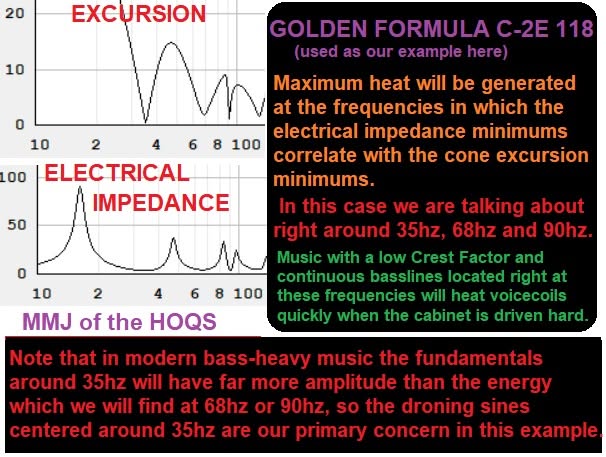
If the music you play happens to have droning basslines focused heavily at 35 Hz, then selecting a subwoofer cabinet with its fundamental tuned to 35 Hz is a recipe for thermal problems. We can avoid this for the most part by having the cabinet tuned a bit lower. Our Paraflex Silver Formula C-2E, the C-2E.3 (which can easily be adapted for a 21″), and the original C-2E 1x21 are all tuned fairly low, and the angle-brace update can be implemented with them. The Paraflex C-2E 2x15 also has a lower tuning option in the plans, and the Paraflex CRAM! 2x15 (such as the one Bradley Steven Katz built) is tuned low as well.
The peak-hold spectral analysis charts below show the distribution of energy in some very bass-heavy tracks. Note where the bassline's energy is centered, and the difference in amplitude referenced to the level at 90 Hz: 20 dB, 19 dB, and 17 dB are all massive discrepancies. Even a more conservative 15 dB suggests a power multiplication factor of 32, which in theory means that if we cross over from our subwoofers to our tops around 80–90 Hz, our subwoofer system would need to handle 32 times more power than our tops (to make up for the 15 dB difference) to play this sort of music at very high levels without the subs running out of headroom before the tops reach their maximum output.
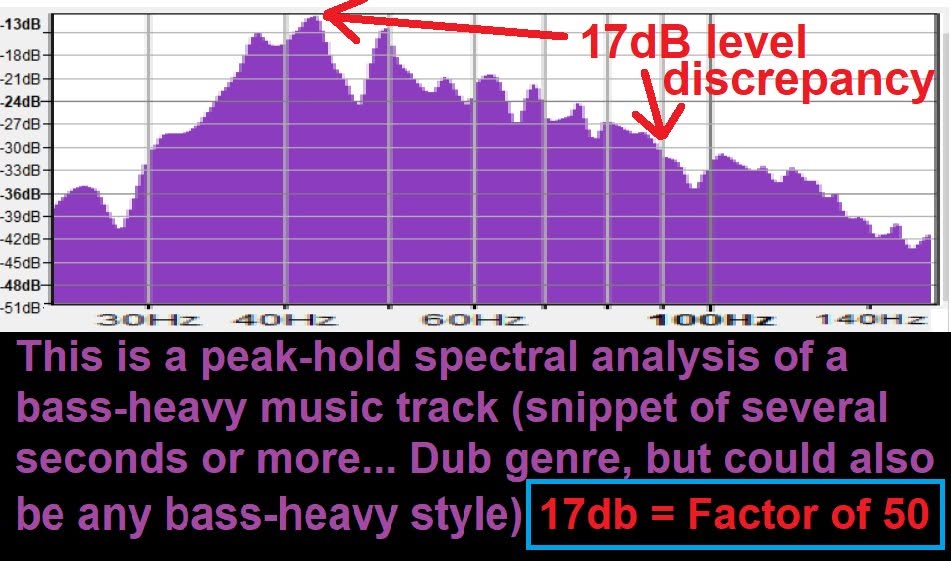
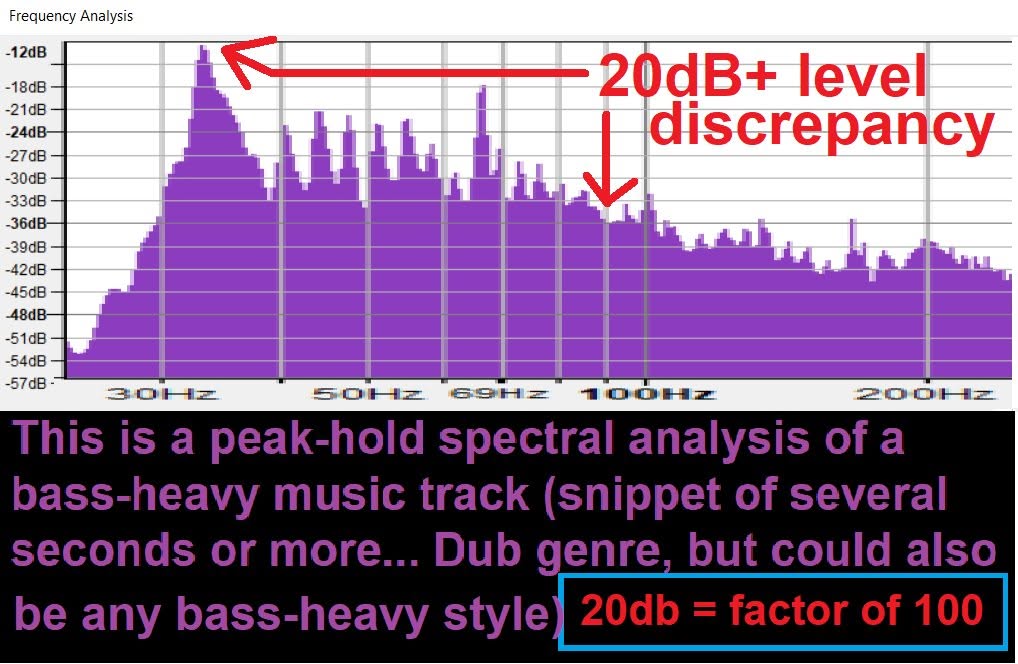
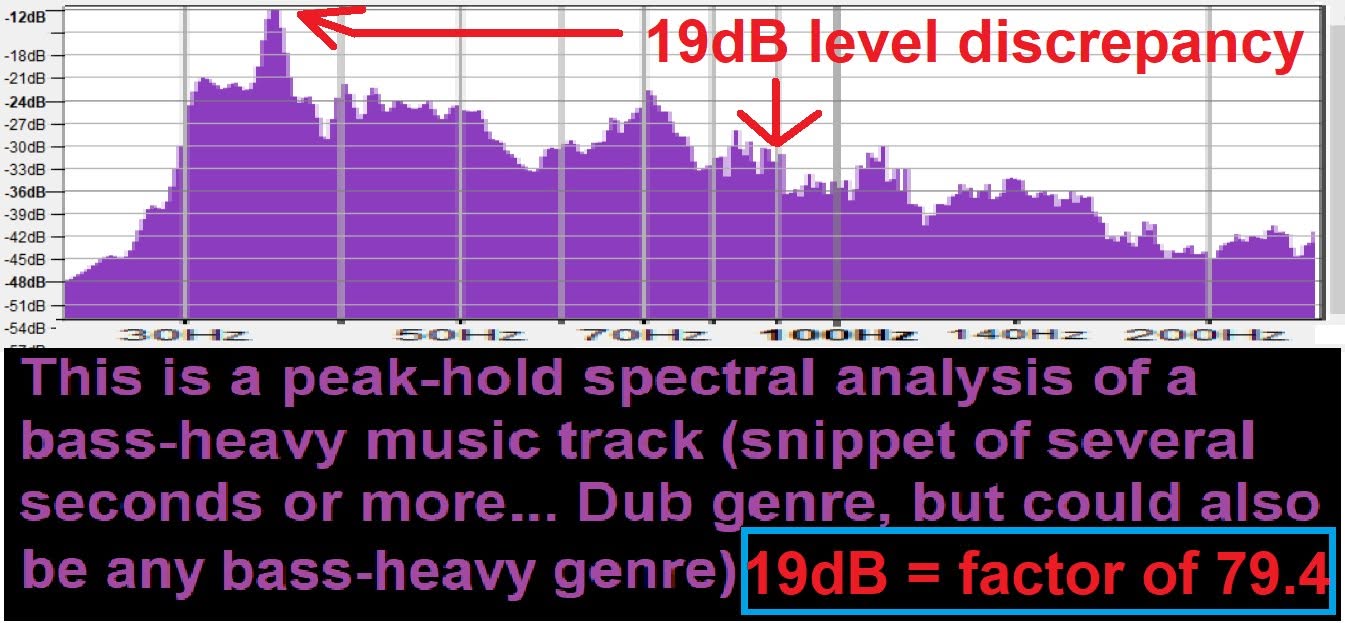
That suggests we'd need a heck of a lot of subwoofers to keep up with only one or two tops. It is true that we need a lot of subwoofers for extreme SPL — but the real world is more forgiving than this line of reasoning suggests. About 10 dB is much closer to what we really need to make up for in a critical high-SPL application (10 dB is a power multiplication factor of 10 — easy to remember).
The type of music you play, at what level, and for how long, are all determining factors. The ratio recommendations below are based on the “worst case” heavy-bass, low-crest-factor, high-SPL scenario described above.
Recommended cabinet ratio guide
One way to figure out what you need is to follow some rough top-to-subwoofer ratio guidelines:
- Paraflex 1x12 top (G#1 style): a 1:3 ratio with Paraflex 1x18 subwoofers, or 1:2 with our Paraflex 1x21 or 2x15 subwoofers using recommended drivers. In other words, a pair of these 1x12 tops can run with six Paraflex 1x18 subs or four 1x21 (or 2x15) subs to come close to matching available headroom.
- Paraflex 2x12 top: double the subwoofer counts given above for the 1x12.
- Paraflex Type “A” 1x12 subwoofer: two of these, loaded with recommended robust drivers, are nearly equivalent to one Paraflex 1x18 sub; three are nearly equivalent to one Paraflex 1x21 or 2x15 sub.
- Paraflex 1x15 subwoofer: two are roughly equivalent to one Paraflex 1x21 sub.
- Paraflex 2x8 top: loaded with capable 8″ drivers, nearly equivalent to the Paraflex 1x12 (G#1 style) top. High-passed a bit higher — or used with kick bins — it gains headroom.
The drivers used will always shift these numbers, so treat them as approximations, not rules set in stone. They're useful for guidance and perspective, and they help you invest wisely: matching headroom means your money is spent more effectively — highly important when resources are limited.
Bending the cabinet ratios
If you'd like to skew the ratios toward fewer subwoofers, choose drivers with higher power handling for your subwoofer cabinets, or choose a Paraflex subwoofer design that uses multiple drivers. Generally speaking, that means larger-diameter voice coils or more voice coils per cabinet (or 18Sound's Tetracoil). A superb, practical example that has been built in multiples is the Paraflex C-2E 2x15 loaded with dual 15DS115 drivers (there's an adaptation that shifts the driver baffles over slightly to give the 15DS115 pole vents more breathing room) — a marvelous combination with tremendous power density for a Paraflex. Less radical, less costly examples: an NTL5000 in the Silver Formula C-2E, or one of the 6″-coil 21″ drivers such as the NSW6021-6 or 21SW152 in the Silver Formula C-2E or Golden Formula C-2A 1x21.
Less can be more when it comes to processing
Paraflex subwoofer systems tend to sound best and perform optimally with very little processing on the subwoofer channel — or none at all, other than the recommended high-pass and low-pass filters. Classic hardware like the BBE Sonic Maximizer or Aphex Aural Exciter isn't needed, which is a great opportunity to simplify your amp rack (perhaps freeing room for another amplifier). This isn't only about sound quality: anything that takes away from the dynamics of your low-frequency content while boosting the average level of low-frequency energy near your cabinet's fundamental tuning increases the potential for thermal buildup. This doesn't apply to what a DJ does on their side when an occasional anemic track needs its bottom end fattened up — that's fine, since it's applied selectively and only when called for.
Be diligent about preventing clipping
Make sure none of the stages in your signal chain are being overloaded. Any component pushed much too hard becomes a source of clipped (flat-topped) waveforms, which are notorious for overheating voice coils. If your DJ is driving the mixer's output meters into the red, take action to prevent it, and make up for it with additional gain in the system's later stages if necessary. Keep a spray bottle or squirt gun handy and squirt the DJ every time they hit the reds, as if you're training an unruly kitten. Be consistent; show no mercy.
Limiters, and how to set them to protect a subwoofer system
Last but not least, limiters are an essential feature if you want to do everything you can to protect your subwoofer system. Trusted manufacturers such as Danley and Powersoft offer a lot of guidance here, so their tutorials, explanations, and formulas are well worth checking out. We'll cover the most basic of basics with a common two-part limiter system: a peak stop limiter and an RMS limiter, each with a very specific function. The goal is to control average power levels while fully preserving the music's crest factor (its dynamic nature), and the key to success is in the settings.
If your DSP limiter system is separate from your amplifier (not integrated), this procedure can either be calculated or, if you prefer the manual approach, done with a trusty AC voltmeter and a tone generator set to 50 or 60 Hz. Disconnect your speakers from the amplifier and connect the AC voltmeter to the output of the channel you're setting the limiter for, with the amp's gain controls fully clockwise.
The peak stop limiter is much like the clip limiter built into many amplifiers. Its purpose is simply to keep your amplifier from clipping on peaks — or, if your amplifier is massively overpowered for your driver, to protect the driver from mechanical damage. Modern heavy-duty, high-excursion subwoofer drivers can withstand some absurdly high peaks, so setting the threshold to limit peak output to the driver's “Program” or “Music Program” rating is reasonable. If your amplifier doesn't have that much voltage available, set the threshold closer to the driver's AES rating (some brands say “RMS” or “Nominal,” which are close enough to AES for our purposes — more on that below). The peak stop limiter's time constants should both be extremely short, practically instantaneous, and the ratio should be very high (infinity, or “brick wall”).
A word on power ratings. Driver manufacturers don't all use the same standards or terminology for power handling, which can cause confusion. Comparing ratings across brands is apples to oranges. We can gain a foothold by understanding the AES 1984 power handling standard and using it as a reference. The AES rating is determined by the driver surviving a two-hour trial in free air fed pink noise filtered to cover a decade of spectrum (20–200 Hz, for example). Pink noise is dynamic, with a crest factor of 6 dB — a vitally important detail (6 dB is a power multiplication factor of 4). That means the conservative average component of this power handling is more like AES divided by 4. Remember this; we'll put it to work later.
Not all brands use AES, but reputable ones have their own alternative that comes close (said to be off by no more than 30%, usually less), and we don't need absolute precision for this job. Respected names like Eminence and B&C also use filtered pink noise over a few hours, which is why ratings aren't far removed from one another. Some brands call their standard “RMS,” others “Nominal” or “Continuous,” but all are roughly equivalent to AES. “Program” or “Music Program” ratings are basically AES + 3 dB, i.e. double the AES rating (3 dB is a power multiplication factor of 2). We don't need to concern ourselves with “Peak” ratings, which add yet another 3 dB. There are other standards out there, but these are the ones you'll meet most often with modern PA drivers.
The RMS limiter is set up to behave like an intentionally slow leveler (AGC). Its very long time constants are what let it retain the music's vital crest factor. Find your RMS limiter's attack, release, and ratio settings (they're sometimes labeled differently):
- Attack: very long — 2,000–3,000 ms (2 to 3 seconds).
- Release (sometimes called “decay”): at least 2× the attack time; some prefer 4× to 6×.
- Ratio (if available): high — at least 6:1, up to 10:1 or more.
We're creating a very slow limiter that intentionally does not respond to peaks. Since the AES rating is determined with pink noise that has a 6 dB (factor of 4) crest factor, imagine what's left if you removed the dynamics from that pink noise: a level of about 1/4 (25%) of the AES (or equivalent) rating. That's our safest, most bulletproof starting target for the RMS limiter.
For the last step, drive the system with the full-strength test signal and adjust the RMS limiter's threshold while watching the voltmeter until the output hits the voltage that corresponds to 25% of the driver's AES (or equivalent) rating. Then stop the signal, disconnect the meter, reconnect the speakers, and play music at party volume for a few hours (or play a gig). If the driver motors aren't getting hot to the touch, great: repeat the procedure with the threshold set for 1/3 (33%) of the rating, and test again at war volume for a few hours. Still running acceptably cool? Fantastic — try 1/2 (50%) next, and so on.
If a driver's motor ever feels uncomfortably hot to the touch, you're surely experiencing thermal power compression losses, which is a sign to back off the average power level. If the outside of the motor is hot, the inside is even hotter. If you'd rather be extra nerdy about it, ask the driver manufacturer for the maximum recommended operating temperature (measured at the magnet structure or wherever they recommend) and check it with an infrared thermometer.
The safe average power (as a percentage of AES) differs from system to system and situation to situation because of many variables — some covered above, like the character of the music and how it interacts with the cabinet design, the length of the show, and differences between rating systems (some drivers are rated more optimistically than others). Even ambient temperature and humidity have some influence.
Calculating target voltage: multiply the desired long-term power limit (watts) by the nominal impedance (ohms), then take the square root. For example, 117 V is 1,700 W into 8 Ω; 82 V is about 850 W; and half of 117 V, 58.5 V, is 425 W. Notice that half the voltage works out to one quarter (25%) of the power. Prefer a calculator? Use an Ohm's law calculator.
Mark Tomlin of Linea Research (also the HOQS Regional Support Director for the UK) suggests the Linea Research method for determining RMS limiter attack time: “100/HPF frequency. So if you have a high pass at 45 Hz it would be 100/45 = 2.22. Then set the release at 2 or 3 times the attack depending how much protection you want.”
Limiter time in dB/s instead of ms? Don't panic — divide 3,250 by the time in milliseconds. A 10 ms attack ≈ 325 dB/s; a 4 ms attack ≈ 800 dB/s.
Tried RMS limiter settings on your own drivers? Tell us what percentage of AES (or equivalent) has worked well for you in the HOQS group.
Further reading
Design update · Type O The Type “O” Playa Edition Update, Explained Why the front panel on the Type O CRAM! 2x18 and 2x21 Playa Edition grew 7 inches, and what it did for ringing around 90 Hz.
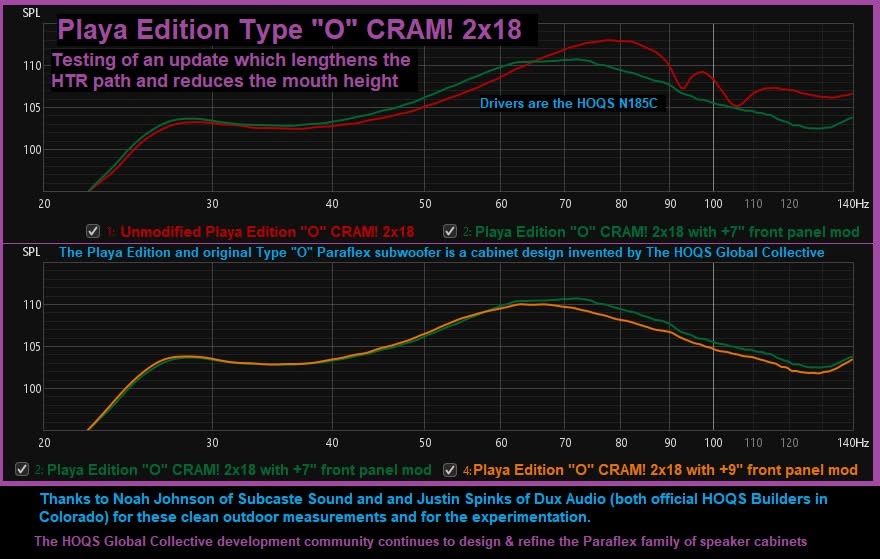
The finishing touches that fully optimized the HOQS Playa Edition Type “O” Paraflex CRAM! 2x18 subwoofer were worked out in the real world, through experiments carried out by Justin Spinks of Dux Audio, Noah Johnson of Subcaste Sound (both in Colorado), and Eric Ross of WAAT — Wiggly Air Audio Technologies — in Florida.
As it turns out, shifting the baffle forward a bit (as these Playa Edition designs do) more than compensates for the change in air volume caused by the forward-facing driver mounting. Because of this, the cabinet's front panel needs to be extended downward — in this case about 7 inches — to lengthen the HTR path. That brings the resonator tuning relationship back into the optimal range, since the cabinet's fundamental tuning has shifted lower in frequency and the cross-sectional area of the HTR section has been reduced somewhat.
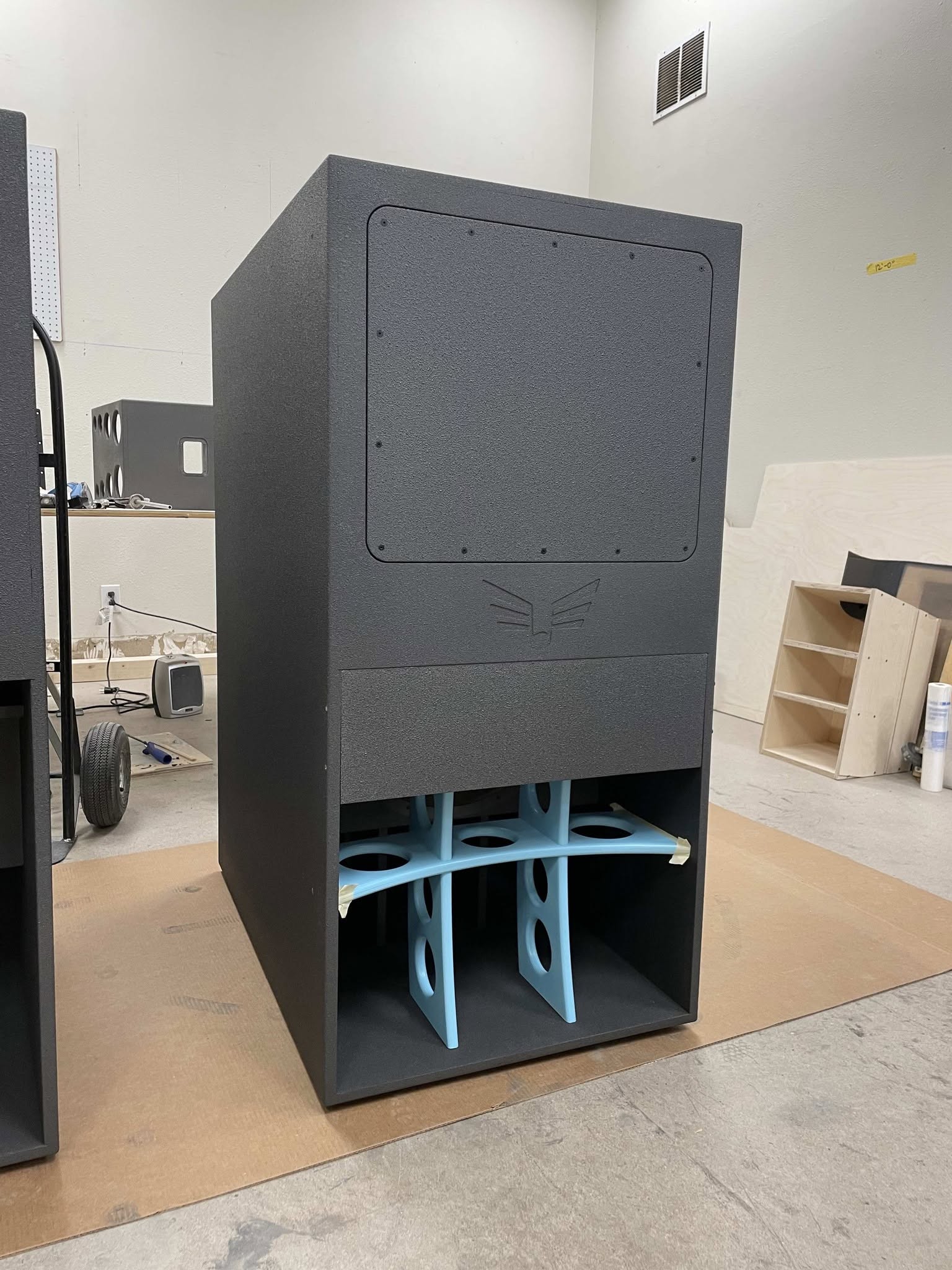
This optimization has a profound effect on performance in the time domain. The waterfall comparison below shows decay time much reduced (improved) between 80 and 100 Hz, centered around 90 Hz. What was previously seen and heard as stored energy, or “ringing,” around 90 Hz is now greatly reduced — practically alleviated, and basically resolved.
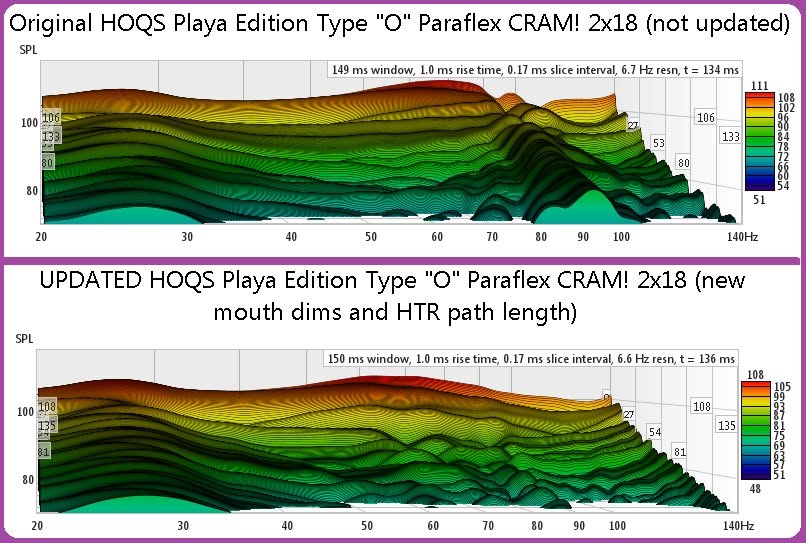
The result is more accurate reproduction of music (or live reinforcement), which subjectively can be expected to sound cleaner and tighter, more detailed and musical, and less fatiguing at high levels. The crossover point can also be set higher without running into problems. Most people don't use that extended upper bandwidth, but it's there if you need it.
What we learned here has been applied to the new “O” CRAM! 2x21 subwoofer, also a Playa Edition style. Its PDF was produced by Robert Moon of Exxotic Audio (just like the 2x18 version), with support from Ty Cention of HOQS Australia and Kaironex Audio and Visual; Robert continues to build the PDFs in Ty's format.
A 9-inch front panel extension was also tested, but it offered little additional benefit. We preferred to keep the mouth area on the large side of optimal so that adding a grille to the cabinet won't noticeably harm performance.
The measured frequency response produced by the F185C is a little different from that of the N185C. The N185C has a slightly stronger motor and doesn't displace as much air in the first section of the LTR, so it looks mildly underdamped in comparison. Keep in mind these measurements are taken at very low power. At higher power (typical operation), the N185C's curve is expected to look more like the F185C's, due to inevitable parameter shift as the coil moves away from center and warms up. Consider it a form of headroom for the N185C: a fair amount of parameter shift can occur before its curve resembles the small-signal F185C measurement.
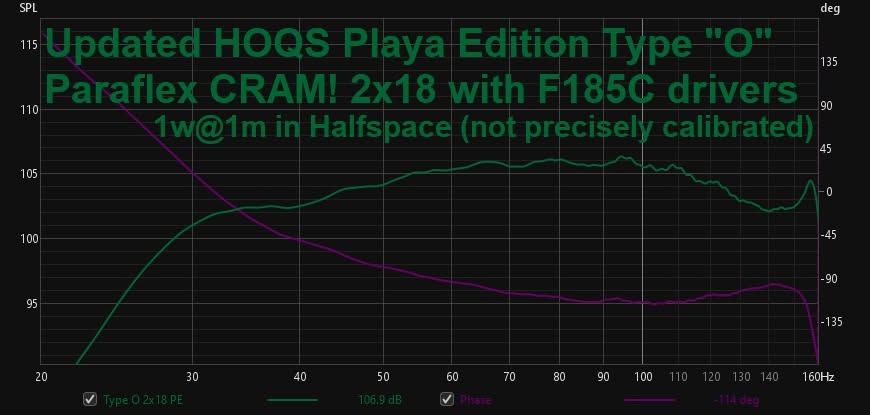
With the baffle and drivers arranged this way, the additional air volume in the first section of the LTR path should benefit the 2x21 cabinet nicely, since 21″ drivers (such as those recommended in the 2x21 plan) typically prefer a little more air volume to work with.
Note: in the “O” CRAM! 2x12 subwoofer, the same real-world optimization required a small adjustment to the size and position of the cabinet's mouth. That change is in the current revision of the PDF.
Original posts
- This update, with measurement videos (HOQS group)
- Type O CRAM! 2x18 Playa Edition (HOQS group)
- Type O CRAM! 2x21 Playa Edition (HOQS group)
Driver power ratings: what do they mean?
Bennett Prescott walks through AES, program, and peak ratings, the perfect companion to the thermal management article above.
Run & Gun Subs: simplifying subwoofer arrays
Bennett Prescott on why common subwoofer setups cover a room poorly, and the simple, free layout changes that fix it.
Download the PDF ↓Quarterwave questions, answered
What makes a PARAFLEX different from a regular ported sub?
A ported (bass reflex) box uses one tuned resonance. PARAFLEX designs are high-order quarterwave systems: the driver works into a series of tuned resonator sections that stack their contributions across the passband. In practice that means noticeably higher output from the same driver and amplifier, at the cost of a more complex yet still manageable fold, as all PARAFLEX subwoofer designs feature almost exclusively 90-degree cuts.
What do Type O, Type C, Type R, and Type A mean?
They're distinct fold geometries within the PARAFLEX system, each drawn in multiple driver sizes. In the current catalog, the Type O family (including the compact CRAM folds and the forward-driver “Playa” editions) covers the highest-output builds with tunings from 25 to 37 Hz; Type C “Classic” is the versatile all-rounder now drawn for everything from twin 15s to a single 21; Type R is the single-driver fold with unusually wide bandwidth; and Type A is the compact entry point. The kick-tops and mid-tops apply the same resonator approach to the 80 Hz-and-up range.
Are the plans really free?
Yes. HOQS publishes every PARAFLEX plan free under Creative Commons BY-NC-ND 4.0. Under that license, individuals may build up to four cabinets for personal use. The plans can't be resold or modified and republished, and commercial production runs through authorized builders like WAAT.
Why buy a flat pack instead of cutting my own?
It isn't about tricky angles — nearly every PARAFLEX cut is a simple 90 degrees. It's about precise cut measurements. Every panel in a CNC flat pack is cut to the exact published dimension, so joints close up tight with no air gaps to leak or buzz, and assembly goes far faster and easier. Machined dados locate each panel and brace exactly where it belongs, and the driver and port cutouts arrive already cut, so the build becomes glue-up and finishing instead of layout and re-cutting.
Do I have to use HOQS drivers?
No — every plan lists vetted alternatives from B&C, Beyma, 18Sound, Faital Pro, BMS, RCF, and others, and the published SPL figures name the reference driver used. The HOQS line was engineered with these cabinets in mind (motor strength, compliance, and excursion matched to the cabinet), but it isn't the right pick for every design — the best driver depends on the cabinet and the job, and we'll help you choose. Stick to the listed models or ask before substituting: quarterwave cabinets are far less forgiving of driver swaps than reflex boxes.
How does WAAT relate to HOQS?
HOQS is the design organization and worldwide community behind PARAFLEX; WAAT Audio is an authorized builder based in Sarasota, Florida, serving the Southeast and beyond — supplying CNC flat packs, HOQS drivers, and finished cabinets built to the official documentation. Design credit for everything on this page belongs to HOQS and its development community; the deepest well of build knowledge is the HOQS Facebook group, where these designs were born and are still being refined.